How a Group-Class Student Went From a 4 at School to a 6 in IB English
I first met Jane in the DP2 winter intensive, which is late to be starting. She was sitting at a 4–5 in English Language and Literature SL, and what she had covered at school had not given her the fundamentals for either paper. Paper 2 was the clearest example: she was scoring around 10 out of 25.
The difficulty sat upstream of the writing. Given a text, she struggled to find the elements in it that could be analysed at all — and on the occasions she did find them, she had no sense of how to divide those observations into paragraphs. Without that, an essay becomes a list of things noticed rather than an argument.
By the winter of DP2 there is not much time left, and she knew it. She had started to treat English as a subject with a ceiling she had already reached, and her confidence had dropped accordingly. That needed managing as much as the content did.
My approach
We started further back than her position in the year would suggest — with how to write an essay at all, and how to approach a text on a first reading. Going back to the beginning felt slow given how little time remained, but there was no version of this that worked by patching gaps in a foundation that was not there.
Alongside that, we worked through the marking criteria directly. Students are often told to “analyse more” without ever being shown what the criteria actually reward, and those criteria are the most concrete description available of what a strong answer looks like. Understanding the IB standard turned a vague instruction into something she could aim at.
The part that mattered most was what happened after each piece of homework. A draft essay was not the end of the task: she took the feedback, revised the essay against it, and resubmitted. A first draft shows what a student can currently do; a revision shows whether the feedback has actually been absorbed. On a compressed timeline, that second signal is worth more.
All of this happened in a short window — the winter intensive, followed by the final exam preparation class.
The results
Jane achieved a 6 in IB English Language and Literature, up from a 4–5 at school. Of all her subjects, English was the one that improved most.
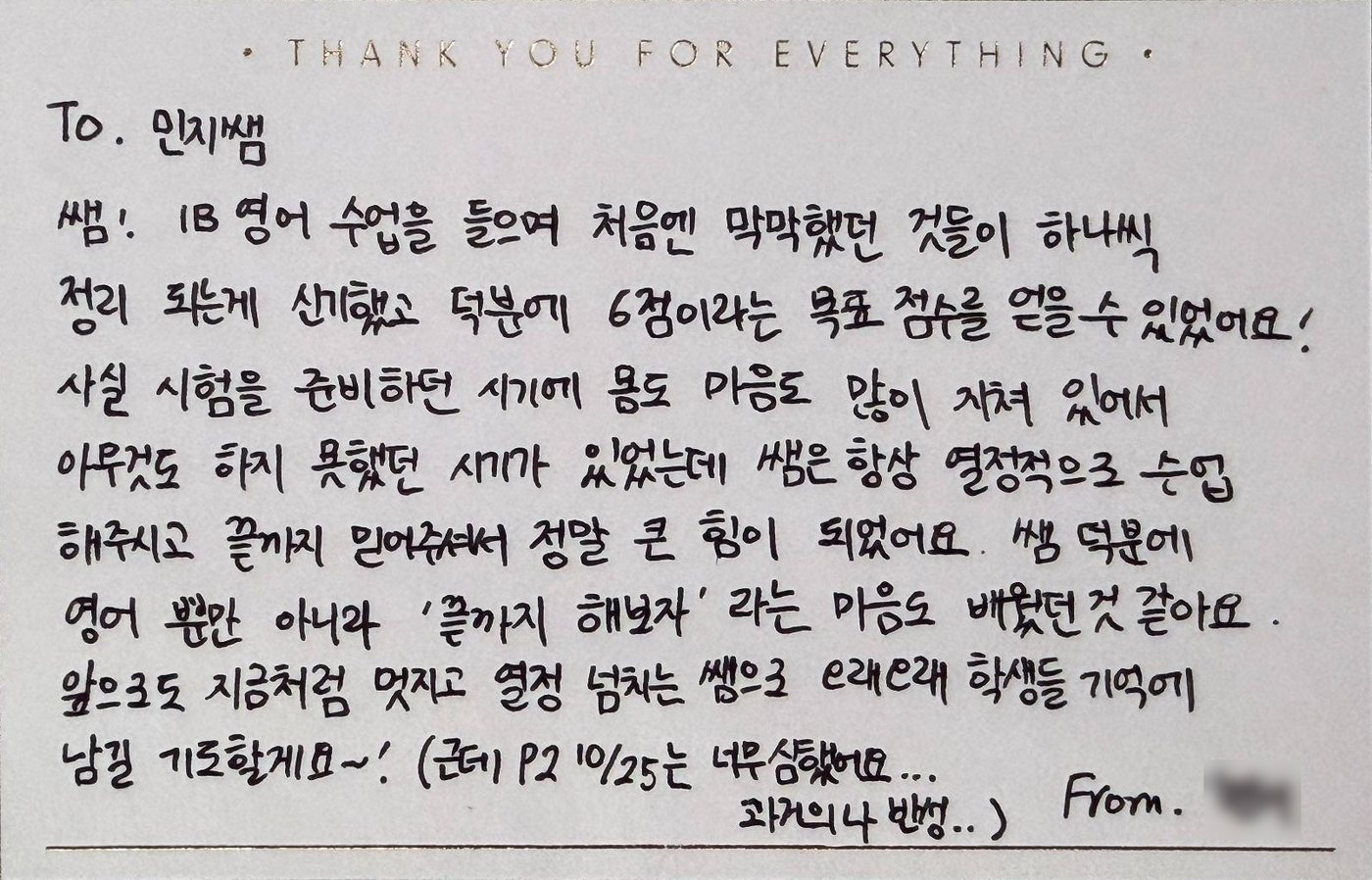
Her analysis became genuinely detailed, which was the reverse of where she started. And rather than forcing every essay into one basic template, she learnt to organise her writing by theme, which let her finish a complete essay inside the time limit instead of running out partway through a structure that did not fit the question. Repeated practice is what held that skill in place through to the exams.
What I would put first, though, is not the grade. She went from feeling that her English had a ceiling to knowing that it did not — and she got there by proving it to herself, working from the position that if she pushed to the end without holding back, she would have nothing to regret.
Why it worked
Jane learnt as much as she did in a group class for a reason that has little to do with the class itself. In a group I cannot give any one student the attention a 1:1 lesson provides, and she made up the difference entirely on her own initiative — asking for feedback during lessons and coming back for more afterwards, consistently.
Her ability to apply that feedback was the other half of it. Some students receive a correction and acknowledge it; Jane received a correction and the next piece of writing was different. Combined with a genuinely good attitude to the work, that is what made a short timeline survivable.
Closing thoughts
Starting the winter of DP2 on a 4–5 leaves very little margin, and the honest assessment at the time was that it would be tight. What made it work was that Jane stopped treating the limitation as fixed and started treating it as something she simply had not worked through yet.
Her final grade was a 6. The part I would point to, though, is that she finished the subject believing she could do it — which was not true of her when we started.
If you would like similar support for IB English Language & Literature (SL), whether to move up a grade band or to secure a 7, our 1:1 tutoring follows the same approach. You can also keep momentum over the holidays with our vacation revision workshops, learn alongside peers in our group classes, or get structured guidance on your IA, EE and ToK assignments. Please feel free to get in touch.