How I Helped an IB Economics Student Improve From a 5–6 to a 7
When Jinsol and I first started working together, he was sitting in the 5–6 range for IB Economics at school. What made his case unusual was that the content itself was never the problem. He picked up new concepts quickly and easily, and he rarely had trouble explaining what a model or a diagram actually meant.
What held him back was everything around that understanding. He struggled to write his answers in the form IB requires, and he had no clear method for studying Economics — no reliable sense of which points carried the marks and which were simply background.
My approach
Because his conceptual understanding was already sound, spending lesson time re-explaining theory would have added very little. I focused instead on the gap between what he knew and what he was able to put on the page.
The first part was prioritisation. Rather than covering the syllabus evenly, we pinpointed the concepts that carry the most weight in the final exam, so that his revision time went where the marks actually are.
The second part was giving him a concrete method for studying Economics:
- Learn the definitions exactly. Economics marks hinge on precise terminology, so we memorised key terms in the exact wording used in the textbook rather than paraphrasing them.
- Weight revision towards recurring topics. We identified the themes that come up repeatedly in the final exam and spent proportionally more time being able to explain those in depth.
- Drill the structure of a long-answer response. We worked specifically on how to build a structured answer for the higher-mark questions, so that the shape of the response became automatic and his thinking could go into the content.
The results
The change showed up first in how he read a question. Where he used to pause and work out what was being asked, he began recognising immediately which concepts and which diagrams the question wanted — often before he had finished reading it.
That recognition fed straight into his timing. Knowing what an answer needed to contain from the outset meant far less time lost deciding where to start, and his time management across a full paper improved considerably.
Most importantly, he learnt to use what he already knew in the way IB asks for it. The knowledge had always been there; what changed was his ability to present it in the form the mark scheme rewards.
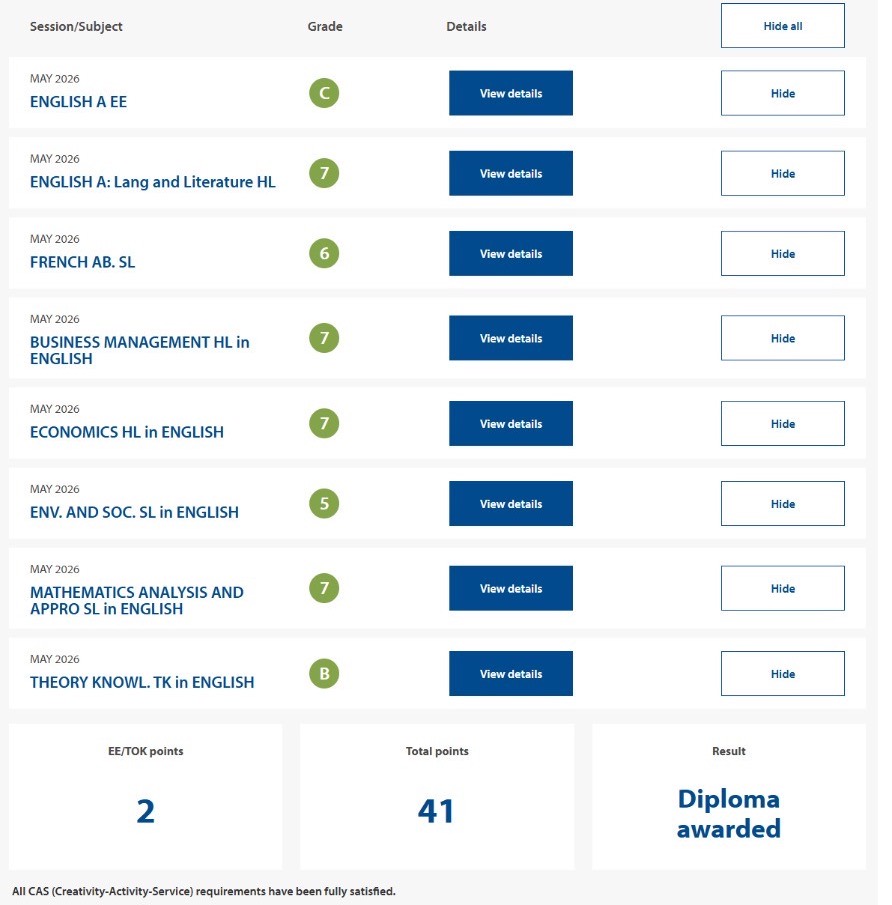
He had been in the 5–6 range at school. In the final IB examinations, he achieved a 7.
Why it worked
The decision that mattered most was not treating this as a content problem. It would have been easy to default to re-teaching topics, because that is what most tutoring looks like — but Jinsol did not need that, and it would have consumed the time we needed for the real issue. Diagnosing that the gap was in expression rather than understanding is what made the rest of the plan possible.
Being deliberate about exact terminology also had an effect out of proportion to the effort it took. Economics rewards precision, and a definition that is nearly right often earns nothing. Learning the terms in their exact textbook form removed a whole category of lost marks that had been quietly costing him on every paper.
Finally, drilling the structure of long-answer responses turned the hardest questions into the most predictable ones. Once the framework was automatic, the higher-mark questions stopped being the part of the paper he had to worry about and became the part where his conceptual strength could actually show.
Closing thoughts
Jinsol’s case is a useful reminder that understanding a subject and scoring well in it are two different skills. He arrived already understanding Economics; what he gained was a method for studying it and the discipline to answer in the way examiners are looking for.
Watching him move from the 5–6 range at school to a 7 in the final examinations — and, more than that, watching him reach the point where he could look at an unfamiliar question and know exactly what it wanted — has been genuinely rewarding.
If you would like similar support for IB Economics, whether to move up a grade band or to secure a 7, our 1:1 tutoring follows the same approach. You can also keep momentum over the holidays with our vacation revision workshops, learn alongside peers in our group classes, or get structured guidance on your IA, EE and ToK assignments. Please feel free to get in touch.