How I Helped an English Lang Lit Student Move From a 6 to a 7
I first worked with Olivia in a 1:1 lesson the summer before DP2, booked to prepare her IA. She was sitting at a 6 in English Language and Literature SL, and her analysis was already good — she could read a text closely and find things in it genuinely worth writing about.
Two things kept that 6 from becoming a 7. The first was that her analysis, while sound, stayed at a general level: she could identify what a text was doing without always pinning down the specific detail that made it work. The second was sentence-level. Her writing did not yet carry her ideas efficiently, so a point that deserved one line took a paragraph, and the sharpest version of her thinking rarely made it onto the page.
The consequence showed up in Paper 1, where her mark moved with the text in front of her. On a passage that suited her she looked like a comfortable 6; on one that did not, she could drop to a 5.
Her school also set very few summative assessments, which meant she was writing almost no full essays under timed conditions. In a subject where the skill fades without regular use, that was a real risk.
My approach
Olivia’s case split cleanly into two kinds of work, so we ran them in parallel.
In the group summer intensive, the focus was breadth and structure. She practised framing essays — deciding what the argument was before writing it — and worked through a wide range of text types, so that no paper could put an unfamiliar format in front of her. Exposure was the point: the more text types she had already analysed, the less her Paper 1 mark could swing on the luck of the passage.
The 1:1 lessons handled everything that had to be specific to her. This is where we worked on sentences — how to say something detailed and say it briefly, so that a precise observation took one clean line rather than three loose ones.
Fixing a recurring habit in someone’s writing means first proving that it recurs, and that is work on my side as much as hers. I read her homework and the writing she produced in class continuously, looking for the patterns that kept coming back. Feedback only becomes genuinely useful once it stops describing a single essay and starts describing a tendency.
The results
Olivia achieved a 7 in IB English Language and Literature.
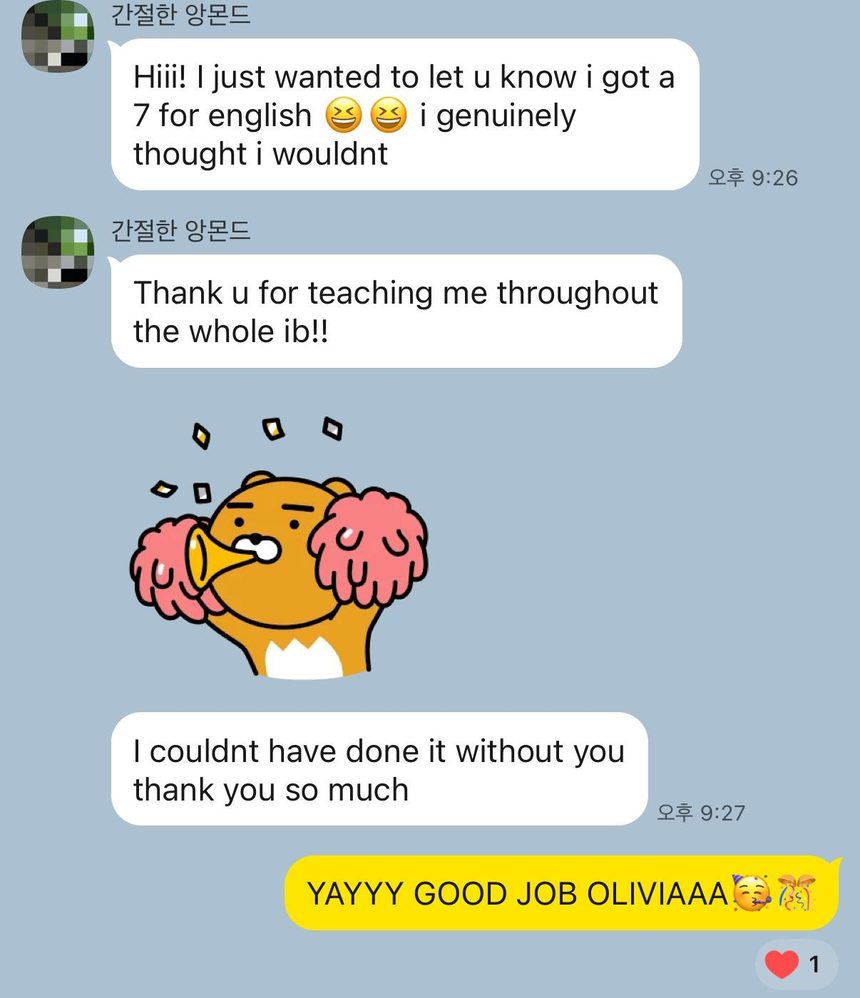
The more telling change was in stability. She had been a student who moved between a 6 and a 7 depending on the paper; in the final exams she was reliably a 7. The swing that had defined her Paper 1 largely disappeared, because the range of texts she had already worked through meant far fewer of them were genuinely unfamiliar.
Her analysis — her strength from the start — ended up being the part we pushed hardest. The aim was to get the maximum out of it, then make sure all of it survived the time limit, so that every idea she reached actually arrived on the page in the time available.
A large part of that came from outlining. She learnt to build a full essay outline in under seven minutes, which changed the shape of the exam for her: the plan stopped being something she improvised while writing, and the time it freed went into the writing itself.
Why it worked
Running group and 1:1 lessons together did more than either would have alone, because the two were doing genuinely different jobs. The fundamentals and the breadth of text exposure work well in a group — that material does not need to be personalised, and seeing a range of responses to the same text is useful in itself. Her specific weakness did need to be personalised, and that is what the 1:1 time was for: taking the same passage and working through how else it could have been analysed, and how else it could have been expressed.
The other reason, and the one I had least to do with, was Olivia herself. She was diligent, her homework arrived consistently, and she wanted a 7 badly enough to keep revising work that was already good. A student who submits everything gives me the material to spot the patterns in the first place; a student who wants the grade that much acts on the feedback rather than filing it away.
Closing thoughts
The gap between a 6 and a 7 in English Language and Literature is often not a gap in understanding. Olivia arrived able to analyse well. What she gained was the precision to say exactly what she had noticed, and the timing to get all of it down.
Watching a student stop hoping for a favourable text — and start knowing the mark will hold whatever comes up — is one of the more satisfying things to see.
If you would like similar support for IB English Language & Literature (SL), whether to move up a grade band or to secure a 7, our 1:1 tutoring follows the same approach. You can also keep momentum over the holidays with our vacation revision workshops, learn alongside peers in our group classes, or get structured guidance on your IA, EE and ToK assignments. Please feel free to get in touch.